
插件目录 / Developer / sandbase-harness
sandbase-harness
已验证 · 实测可装 sandbaseai
功能简介
通过 stdio MCP 把自托管 SandBase Agent Runtime 接入 DeepSeek Harness,提供列出 Agent、创建/运行会话、读取产物和停止任务等工具。
推荐 — 实测可用且热门
通过 stdio MCP 把自托管 SandBase Agent Runtime 接入 DeepSeek Harness,提供列出 Agent、创建/运行会话、读取产物和停止任务等工具。 实测能干净安装、正常启动。634+ stars,社区认可度高,是低风险选择。
「已验证」表示我们的自动化 CI 在干净 profile 里实际执行了 dsh plugin add 并启动成功——仅此而已。功能描述与版本兼容性均为作者声明。这不是安全审计,也不代表对第三方代码的背书。
README
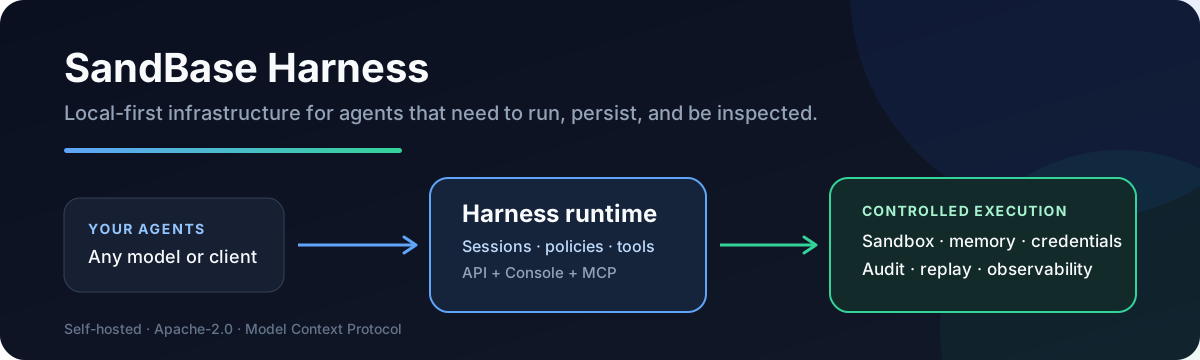
SandBase Harness





A local-first runtime for AI agents. Sessions, sandboxed tools, memory,
credentials, audit trails, and a built-in Console — all running on your
machine or in your own infrastructure.
Looking for a lightweight bridge instead of a full runtime? SandBase CLI
connects 25 AI client targets to 2,000+ models through a local stdio MCP bridge.
Need hosted model and media APIs instead? SandBase provides one interface for
LLM, image, and video generation APIs,
with the API quickstart covering keys and first calls.
git clone --branch v0.3.7 --depth 1 https://github.com/sandbaseai/sandbase-harness.git
cd sandbase-harness
npm ci
npm run build
mkdir ../my-agents && cd ../my-agents
node ../sandbase-harness/dist/index.js init
node ../sandbase-harness/dist/index.js start
# open http://127.0.0.1:3000/dashboard
Choose SandBase Harness when you need more than a model loop:
| Need | What Harness provides |
|---|---|
| Run generated code safely | Local, Docker, Kubernetes, and self-hosted worker sandboxes |
| Inspect long-running agents | Persistent sessions, resumable event streams, audit, and replay |
| Control tool access | MCP toolsets, credential vaults, permission policies, and approvals |
| Operate any model | OpenAI, Anthropic, MiniMax, and OpenAI-compatible providers, including DeepSeek V4 |
| Keep infrastructure yours | Local-first SQLite and file storage with no required hosted control plane |
If this runtime solves a real agent-infrastructure problem for you,
star the repository so other builders can find it.
Try it in Codespaces

The included development container installs dependencies and builds the runtime.
When the terminal is ready, start the server on the forwarded port:
node dist/index.js start --host 0.0.0.0
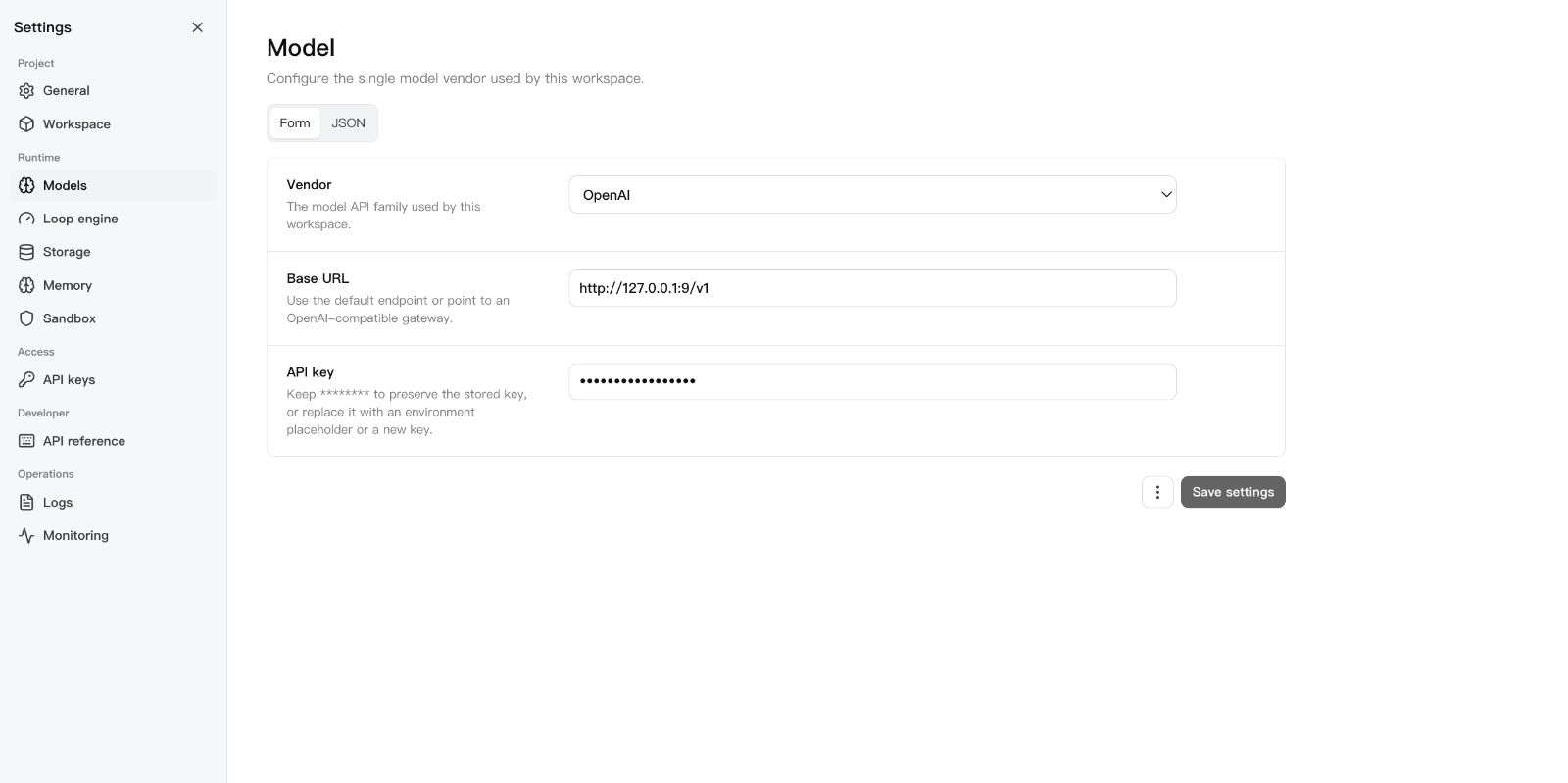
Open the forwarded SandBase Harness Console port, then configure a model in
Settings > Models. Codespaces usage may be billed by GitHub; the local
quick start below remains free and keeps all runtime data on your machine.
Why
Agent SDKs handle the model loop. Production agents need more: persistent
sessions, tool governance, sandbox boundaries, credential handling, memory,
auditability, and a UI for humans to inspect what happened. managed-agents
is that runtime layer — not a visual workflow builder and not another model SDK.
Features
- Claude Managed Agents-style
/v1API and local Console - SQLite-backed agents, sessions, environments, credential vaults, memory
stores, files, skills, and API keys — SQLite metadata by default - local file/skill bytes stored in the workspace state directory
- Resumable Server-Sent Events for session replay and debugging
- One active model provider boundary configured through Settings V2
- Sandbox backends: local process, Docker (per-session containers), Kubernetes
(kubectl exec/cp), self-hosted worker queue - Settings V2: one workspace model vendor, loop engine, storage, memory,
sandbox — with validation, form/JSON modes, and restart flow - MCP toolsets, permission policies, built-in tools, and skill packages
- DeepSeek Harness bridge over MCP stdio for agents, sessions, streamed turns,
artifacts, and cancellation - TypeScript SDK at
managed-agents/sdk - Release gate:
npm run release:check
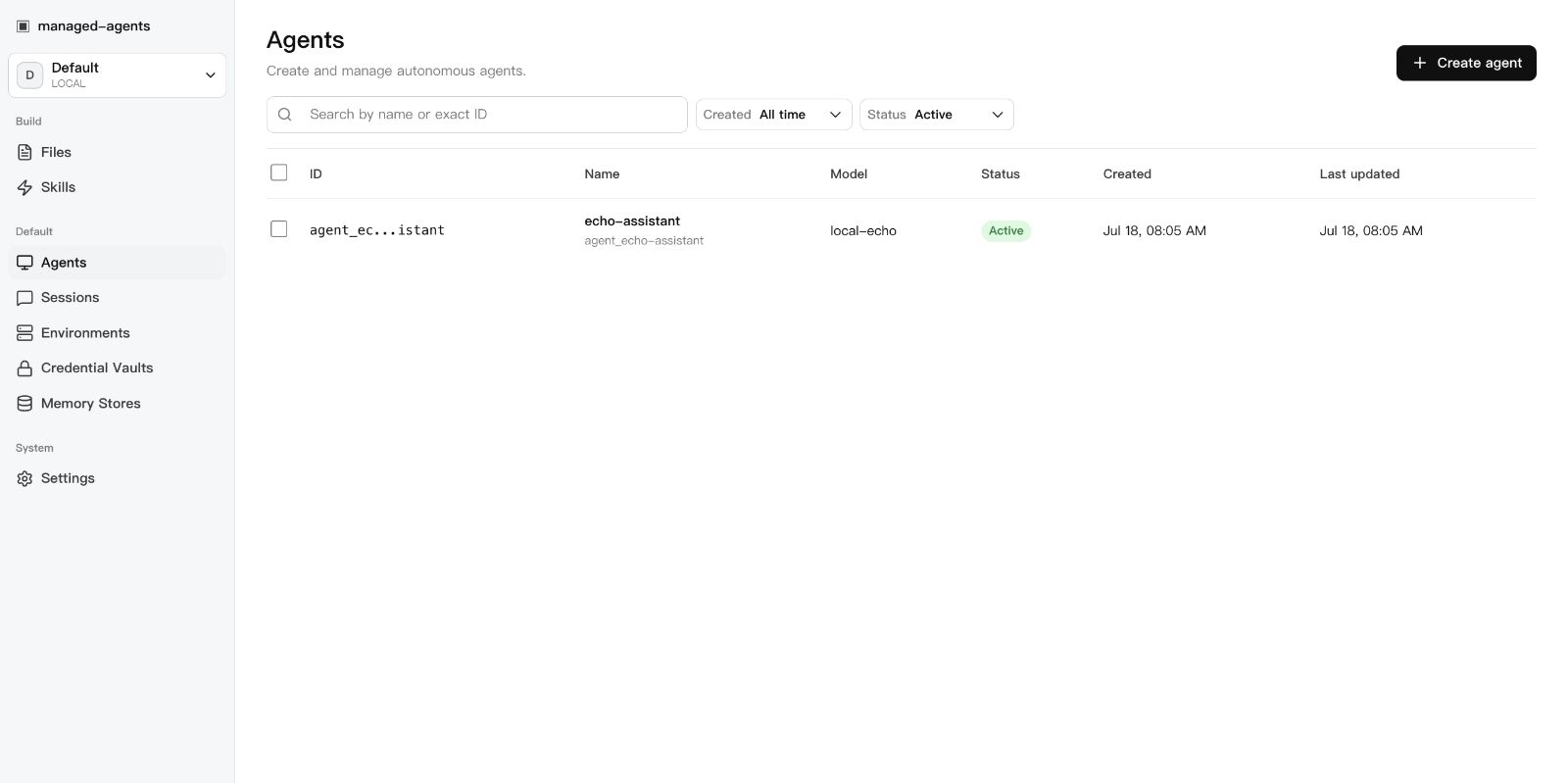
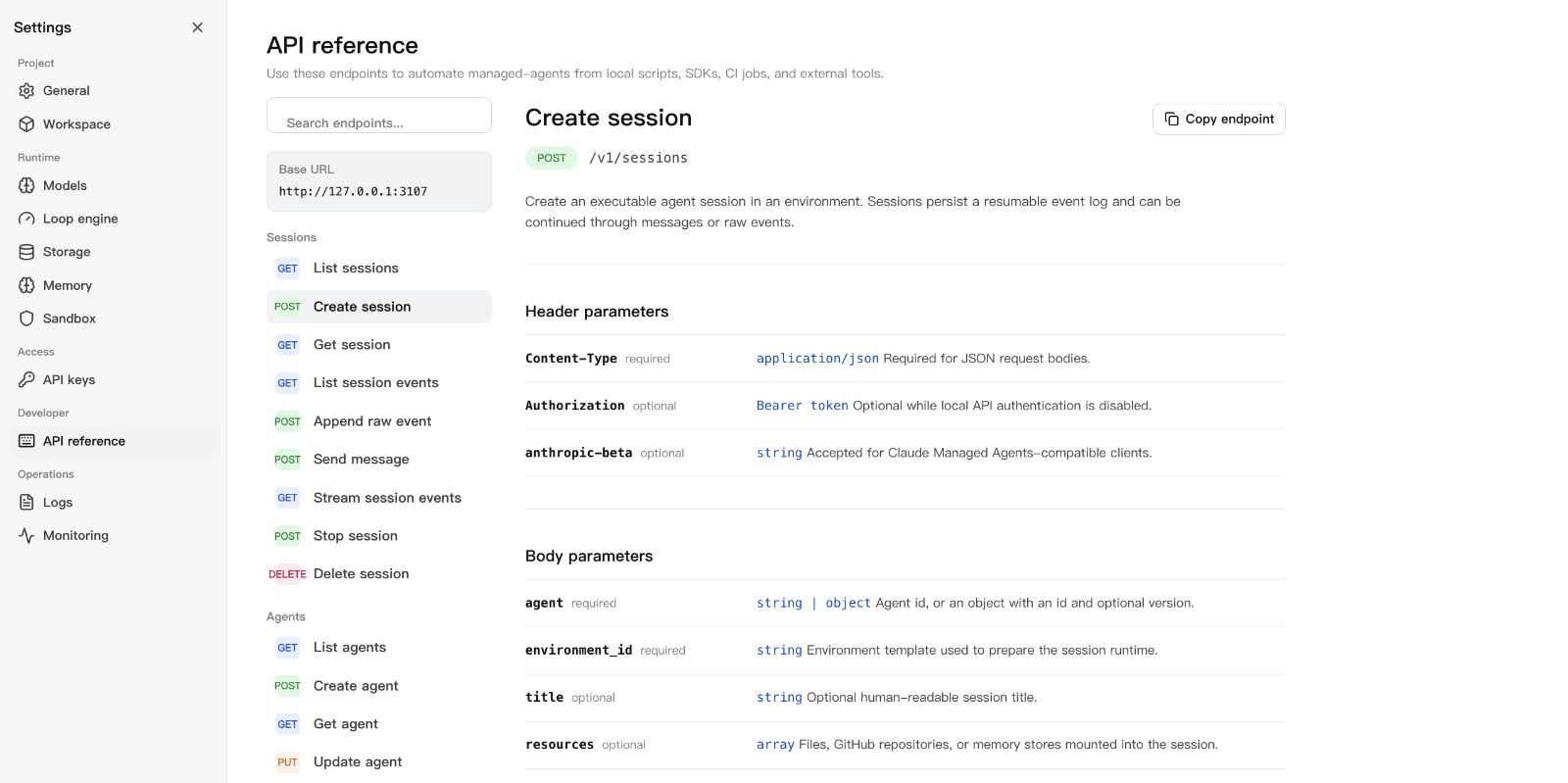
Screenshots
| Console overview | Settings | API reference |
|---|---|---|
 |
 |
 |
Requirements
- Node.js 22+
- npm 10+
- A model provider API key (OpenAI, Anthropic, MiniMax, or an OpenAI-compatible endpoint)
- Docker (optional, for Docker-backed sandboxes)
DeepSeek Harness
Run this project as a DSH plugin instead of treating dsh-plugin as discovery
metadata only. Install the bundle into a DSH profile, start managed-agents,
then boot that profile:
export MANAGED_AGENTS_URL=http://127.0.0.1:3000
# Run from the sibling my-agents workspace created above.
dsh plugin --profile web add -w ../sandbase-harness
dsh web
The profile installs the verified source checkout directly; it does not resolve
the unrelated unscoped npm package. The patch starts the bundled MCP entry over
stdio. DSH can then list agents,
create and run sessions, inspect results and artifacts, and stop work through
native mcp__sandbase__* tools. Seeexamples/deepseek-harness for the full
tool list and authenticated-runtime configuration.
For a walkthrough that starts with DSH and adds this runtime as a real
third-party plugin, read the
DeepSeek Harness developer guide.
Pair the plugin with SandBase Skills to give the same DSH project a portable,
source-verifiable research workflow:
npx --yes github:sandbaseai/sandbase-skills add multi-source-search
dsh web
This installs the complete Skill into .dsh/skills/multi-source-search, DSH's
project-scoped discovery directory. It runs from GitHub source and needs no
SandBase account when DSH already provides web/search tools.
For a complete, reproducible workflow that combines the evidence ledger with
sandboxed execution, credentials, audit, and replay, read
Build an Auditable Research Agent.
New to DSH profiles, plugin composition, tool policy, or session semantics? The
independent DeepSeek Harness Handbook
provides source-backed quickstarts, architecture maps, and troubleshooting for
the runtime layers used by this integration. Start with the local-browser
Install Doctor
for installation evidence, or use the
Failure Router
to identify the first broken runtime boundary.
Quick Start
git clone --branch v0.3.7 --depth 1 https://github.com/sandbaseai/sandbase-harness.git
cd sandbase-harness
npm ci
npm run build
mkdir ../my-agents && cd ../my-agents
node ../sandbase-harness/dist/index.js init
node ../sandbase-harness/dist/index.js start
Open http://127.0.0.1:3000/dashboard, go to Settings > Models, paste your
API key, and you're running.
The unscoped managed-agents name on npm is not this project. Until an
official scoped package is announced in this repository, install only from the
tagged GitHub source release shown above. Do not run npx managed-agents ornpm install managed-agents.
The six-tool MCP bridge is published as a multi-architecture OCI image. Start
the Harness API, then add this stdio command to an MCP client:
docker pull ghcr.io/sandbaseai/sandbase-harness-mcp:0.3.7
docker run --rm -i \
  -e MANAGED_AGENTS_URL=http://host.docker.internal:3000 \
  ghcr.io/sandbaseai/sandbase-harness-mcp:0.3.7
For an authenticated remote runtime, also pass MANAGED_AGENTS_API_KEY. The
container image contains only the MCP bridge; agent sessions and sandbox work
remain in the connected Harness runtime. Every release image is built from the
matching Git tag for linux/amd64 and linux/arm64, includes OCI source and
MCP ownership metadata, and receives a GitHub build-provenance attestation.
Portable Agent Plugin
Copilot CLI, VS Code, and other Agent Plugins 1.0 clients can install the same
OCI-backed MCP bridge directly from this repository. Start the Harness API and
Docker first, then expose its URL to the plugin process:
export MANAGED_AGENTS_URL=http://host.docker.internal:3000
# Optional when the runtime requires authentication:
export MANAGED_AGENTS_API_KEY=your-runtime-key

copilot plugin install sandbaseai/sandbase-harness:agent-plugin
The plugin passes these environment variables through to the pinnedghcr.io/sandbaseai/sandbase-harness-mcp:0.3.7 image. It does not store a key
in plugin.json, mcp.json, or the installed plugin files. On Linux, the
plugin's Docker command maps host.docker.internal through host-gateway.
For development from the latest main branch:
git clone https://github.com/sandbaseai/sandbase-harness.git
cd sandbase-harness && npm ci && npm run build
cd .. && mkdir my-agents-dev && cd my-agents-dev
node ../sandbase-harness/dist/index.js init
node ../sandbase-harness/dist/index.js start
Workspace Layout
my-agents/
├── agents/                  # Seed agent definitions (YAML)
│   └── assistant.yaml
├── skills/                  # Seed skill packages
│   └── example-skill/
│       └── SKILL.md
└── .managed-agents/         # Runtime state (gitignored)
    ├── config.yaml          # Workspace configuration
    ├── data.db              # SQLite metadata
    ├── logs/runtime.log
    ├── files/               # Uploaded file bytes
    ├── skills/              # Uploaded skill packages
    ├── snapshots/           # Session workspace snapshots
    └── sandbox/             # Local session sandboxes
Configuration
.managed-agents/config.yaml:
model:
  provider: openai
  api_key: ${OPENAI_API_KEY}

storage:
  metadata: { provider: sqlite, options: {} }
  artifacts: { provider: local, options: { base_path: files } }
Agents pick concrete model IDs (gpt-4o, claude-sonnet-4-20250514,openai/gpt-5.5). The workspace config only says how to reach the model
service.
For DeepSeek V4 Pro/Flash configuration, including maximum reasoning effort,
see DeepSeek V4.
For first-class MiniMax configuration, regional endpoints, and the supported
MiniMax-M3 and MiniMax-M2.7 model IDs, see MiniMax.
CLI
managed-agents init
managed-agents start [--host 127.0.0.1] [--port 3000]
managed-agents list
managed-agents reload
managed-agents chat <agent-id> --message "hello"
managed-agents template list | install <name> | create <name>
API Examples
Create an agent:
curl -X POST http://127.0.0.1:3000/v1/agents \
  -H "Content-Type: application/json" \
  -d '{
    "name": "Incident commander",
    "model": "gpt-4o",
    "system": "You are an on-call incident commander.",
    "tools": [{ "type": "agent_toolset_20260401" }]
  }'
Create an environment (local sandbox):
curl -X POST http://127.0.0.1:3000/v1/environments \
  -H "Content-Type: application/json" \
  -d '{
    "name": "Default local",
    "config": { "hosting_type": "local", "sandbox_provider": "local" }
  }'
Create a Docker-isolated environment:
curl -X POST http://127.0.0.1:3000/v1/environments \
  -H "Content-Type: application/json" \
  -d '{
    "name": "Docker sandbox",
    "config": {
      "sandbox_provider": "docker",
      "image": "node:22-slim",
      "resources": { "memory": "1g", "cpu": 1 }
    }
  }'
Start a session:
curl -X POST http://127.0.0.1:3000/v1/sessions \
  -H "Content-Type: application/json" \
  -d '{
    "agent": "agent_...",
    "environment_id": "env_...",
    "title": "Triage SENTRY-123"
  }'
Send a message:
curl -X POST http://127.0.0.1:3000/v1/sessions/SESSION_ID/messages \
  -H "Content-Type: application/json" \
  -d '{ "content": "Investigate the alert." }'
Resume the event stream:
curl -N http://127.0.0.1:3000/v1/sessions/SESSION_ID/events/stream \
  -H "Last-Event-ID: 42"
SDK
import { ManagedAgentsClient } from 'managed-agents/sdk';

const client = new ManagedAgentsClient({
  baseUrl: 'http://127.0.0.1:3000',
});

const session = await client.sessions.create({
  agent: 'agent_...',
  environment_id: 'env_...',
});

for await (const event of client.sessions.chat(session.id, 'Hello')) {
  if (event.type === 'agent.message_chunk') {
    process.stdout.write(event.delta ?? '');
  }
}
The /v1 API follows Claude Managed Agents resource shapes, so you can also
point the Anthropic SDK at the local runtime:
import Anthropic from '@anthropic-ai/sdk';

const client = new Anthropic({
  apiKey: process.env.MANAGED_AGENTS_API_KEY ?? 'local-dev-key',
  baseURL: 'http://127.0.0.1:3000',
});

const session = await client.beta.sessions.create({
  agent: 'agent_...',
  environment_id: 'env_...',
});
Authentication
Open by default. Authentication activates when at least one API key exists:
# Static key via environment
export MANAGED_AGENTS_API_KEY=sk-local-example

# Or create a managed key
curl -X POST http://127.0.0.1:3000/v1/api-keys \
  -H "Content-Type: application/json" \
  -d '{ "name": "Local Console" }'
Clients send Authorization: Bearer <key>.
Agent Definition
Agents are YAML files in agents/:
name: Incident commander
description: Triages alerts and coordinates response.
model: gpt-4o
system: |-
  You are an on-call incident commander.
mcp_servers:
  - name: sentry
    type: url
    url: https://mcp.sentry.dev/mcp
tools:
  - type: agent_toolset_20260401
    default_config:
      permission_policy: { type: always_ask }
    configs:
      - name: bash
        permission_policy: { type: always_ask }
  - type: mcp_toolset
    mcp_server_name: sentry
skills:
  - type: custom
    skill_id: skill_...
metadata:
  template: incident-commander
Development
npm ci
npm run typecheck    # src + tests
npm test             # vitest
npm run build        # runtime + console + SDK
npm run release:check  # full local release gate
release:check runs typecheck, tests, both builds, npm pack --dry-run, CLI
init smoke, and examples/basic startup smoke.
SandBase Ecosystem
- SandBase Skills — 88 installable
Agent Skills for research, social intelligence, marketing, and business
workflows across Codex, Claude Code, Cursor, Gemini CLI, and other clients. - SandBase CLI — connect Cursor, Claude Code,
Codex, Windsurf, Gemini CLI, OpenCode, and other MCP clients to 2,000+ AI
models with one onboarding command. - DSH Plugin Store — discover,
filter, install, and manage community DeepSeek Harness plugins from the native
Settings experience. - SandBase — hosted agent infrastructure, model access,
tools, and managed sandboxes.
Documentation
Community Guides
- Self-host the SandBase agent runtime
by SSD Nodes — an independent VPS walkthrough covering installation, agent
configuration, MCP servers, sandbox modes, and reverse-proxy deployment. The
article demonstrates v0.3.2; use the current release command above for v0.3.7.
License
安装
装一次目录插件,之后本站所有插件都能让 DeepSeek Harness 自动找、自动装:
dsh plugin add dshbase-catalog然后对 agent 说「帮我装 sandbase-harness」,它会在目录里找到并自动安装。文档:dshbase-catalog · 已验证场景包。
该插件是 GitHub 源码(未发 npm)——直接从仓库装:
Web profile:
dsh plugin --profile web add github:sandbaseai/sandbase-harnessHeadless(CLI)profile:
dsh plugin --profile headless add github:sandbaseai/sandbase-harness实测报告
验证通过:从 GitHub 源码完成 L1 安装 + L2 加载 + L3 运行(dsh 0.1.0-rc.6)。
使用场景
扩展 agent 的编码能力面——给它一个新工具、工作流或集成,让它接手以前做不了的开发任务。
适合谁
想让 dsh 在真实代码库上像队友一样干活的开发者——能改、能跑、能验证,而不只是回答问题。
二次开发建议
工具/命令面就是缝:暴露更多 SDK 能力、加更聪明的上下文接线,或收紧改代码与验证之间的循环。
分享徽章
把这枚徽章粘进 README——它会链回本页,实测状态变化时自动更新:

[](https://dshbase.com/zh/plugins/sandbase-harness/)<a href="https://dshbase.com/zh/plugins/sandbase-harness/"><img src="https://dshbase.com/badges/sandbase-harness.svg" alt="dshbase 实测可装"></a>