
Plugin directory / Developer / dsh-multica-runtime
dsh-multica-runtime
Unverified multica-ai
What it does
Support dsh runtime on Multica.
Unverified — not yet verified
Support dsh runtime on Multica. Not yet verified — install and test it yourself.
“Unverified” means our automated CI has not yet installed this plugin. Feature descriptions and version compatibility are the author’s claims. This is not a security audit and not an endorsement of third-party code.
README
Multica DSH Runtime
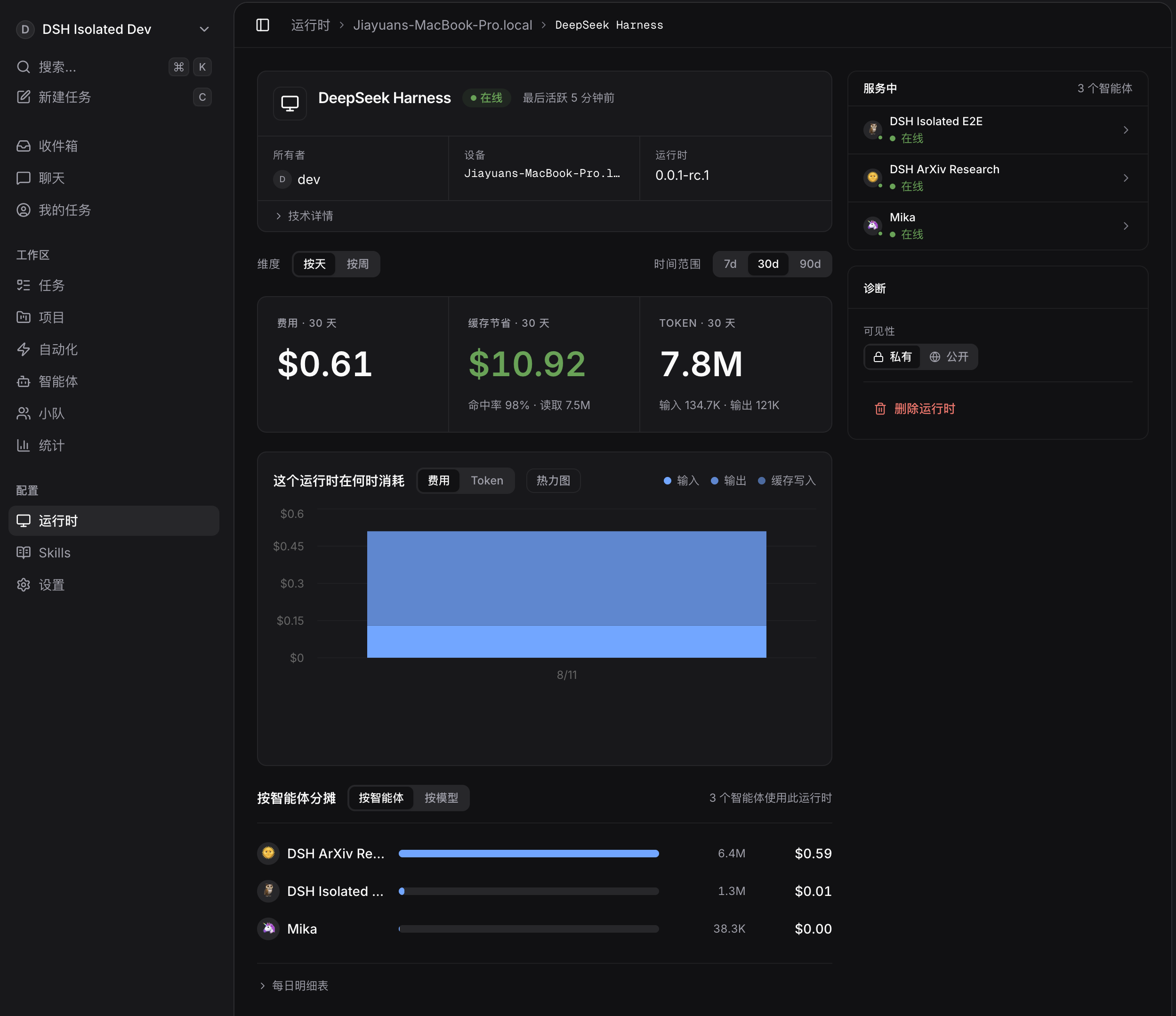
Private, out-of-tree runtime bridge between Multica and the public
DeepSeek Harness. It exposes
a versioned JSONL protocol over stdio and composes over@deepseek-ai/dsh-base. It does not require changes to DeepSeek Harness.
Privacy
- This repository contains only the Multica integration layer. It does not
vendor or redistribute DeepSeek Harness source code. - Never commit API keys, MCP secrets, session logs, or generated profiles.
- DSH telemetry is disabled by the bundle patch.
- stdout is protocol-only; diagnostics go to stderr.
Local development
The DSH packages used by this plugin are public npm packages. This checkout is
currently validated against @deepseek-ai/[email protected] and its matching@deepseek-ai/dsh-* package family.
pnpm install
pnpm check
pnpm build
Install the local bundle into a DSH profile after building it:
dsh plugin --profile multica add /absolute/path/to/multica-dsh-runtime
The plugin supports:
dsh --profile multica --probe
dsh --profile multica --list-models
dsh --profile multica --stdio
Multica discovers the profile only after --probe returns protocol version 1.
For a non-standard DSH installation, point the daemon at its launcher:
export MULTICA_DSH_PATH=/absolute/path/to/dsh
The runtime contract includes:
- model and thinking-level discovery from DSH itself;
- committed text, reasoning, tool, result, and token-usage events;
- cooperative cancellation and durable session resume;
- canonical Multica MCP configuration translated to DSH stdio or
streamable-HTTP clients; - per-runtime/agent session roots supplied by the Multica daemon;
- headless one-shot approvals, with no interactive question surface.
- narrowly forwards only Multica's server-minted
mat_task token into DSH's
otherwise credential-scrubbed shell, so in-taskmulticacommands retain
task attribution without exposing model-provider credentials.
The local .local/ tree is ignored. It may hold an isolated DSH home and a
development launcher, but neither belongs in source control.
DEEPSEEK_API_KEY is read by DSH's credential provider at process runtime. It
must not be stored in this repository.
Install
Install the catalog once, then DeepSeek Harness can find and install any plugin from this site automatically:
dsh plugin add dshbase-catalogThen say "install dsh-multica-runtime for me" — your agent finds it in the directory and installs it. Docs: dshbase-catalog · verified packs.
This plugin is GitHub source (not published to npm) — install it straight from the repo:
Web profile:
dsh plugin --profile web add github:multica-ai/dsh-multica-runtimeHeadless (CLI) profile:
dsh plugin --profile headless add github:multica-ai/dsh-multica-runtimeTest report
Not yet L3-verified — see failure note below if we already ran it.
Note: 验证: runtime-fail (0.1.0-rc.6) Browse all pending failures →
When to use it
Extend the agent's coding surface — give it a new tool, workflow, or integration so it handles a dev task it couldn't before.
Who it's for
Developers who want dsh to behave like a teammate on real codebases — editing, running, and verifying changes rather than just answering.
For developers — extending it
The tool/command surface is the seam: expose more of the SDK, add smarter context wiring, or tighten the loop between code changes and verification.
Share this badge
Drop this badge into your README — it links back here and updates automatically when our test status changes:

[](https://dshbase.com/plugins/dsh-multica-runtime/)<a href="https://dshbase.com/plugins/dsh-multica-runtime/"><img src="https://dshbase.com/badges/dsh-multica-runtime.svg" alt="dshbase listed"></a>